Saykal Pars TD / Trailer Reversing: From Blind Spots to Intelligent Radar Assistance Systems
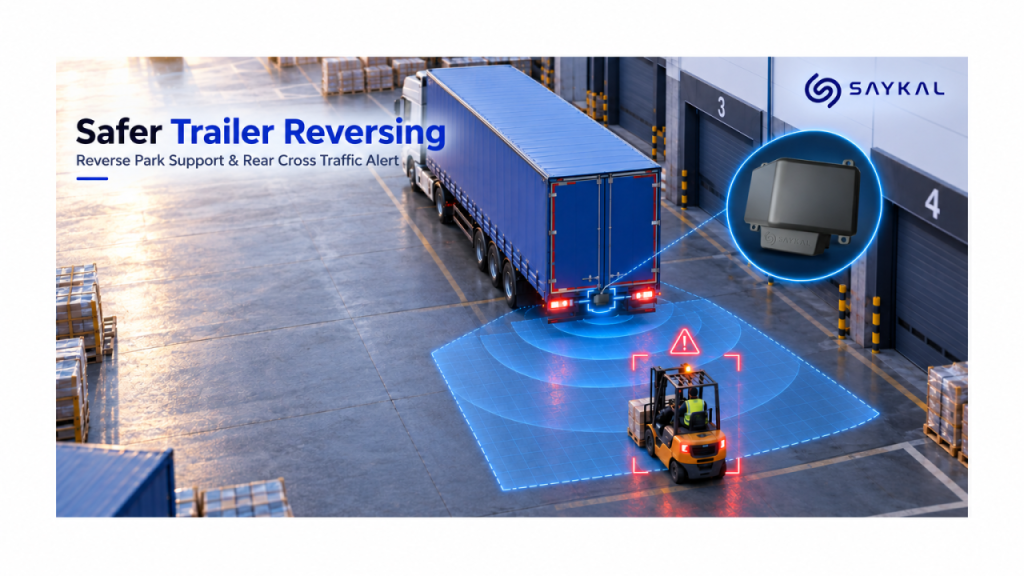
Reversing with a trailer is one of the most challenging driving operations, as the driver needs to monitor the surrounding environment from several angles at the same time. The long vehicle geometry, limited visibility directly behind the trailer, and other vehicles or machinery moving nearby can make manoeuvring even more difficult, especially in confined areas.
The Health and Safety Executive (HSE) states that approximately one quarter of workplace vehicle-related fatalities occur during reversing operations. HSE also recommends considering warning and proximity detection systems that can help drivers understand their surroundings when reversing cannot be avoided. (Workplace Transport Safety: A Brief Guide, page 3)
Although mirrors provide the driver with essential visibility around the vehicle, large vehicles can still have areas behind or around them that are not directly visible to the driver. HSE recommends considering additional technologies such as extra mirrors, reversing sensors and camera systems for vehicles with limited visibility. (A Guide to Workplace Transport Safety, page 45)
For this reason, reversing assistance for trailers is not only about detecting an obstacle. A more complete approach is needed to communicate distance information clearly to the driver, monitor moving objects around the vehicle, and provide additional driving assistance in critical situations.
Radar-Based Reversing Assistance
Developed by SAYKAL, PARS TD – Park Assist Radar Sensor Trailer Docking is a radar-based driver assistance system designed to support reversing operations for trailers and semi-trailers.
The system continuously monitors the area behind the vehicle and informs the driver according to the distance of the detected object through the trailer’s rear position lamps and an audible warning device. At critical distances, depending on the system configuration, it can also send a braking request to the trailer EBS. (PARS TD – Park Assist Radar Sensor Trailer Docking Datasheet, page 3)
With its radar technology and 180° horizontal field of view, PARS TD can monitor a wide area behind the trailer. The system has a detection range of 0.2–10 metres and a distance data resolution of 1 cm. (PARS TD – Park Assist Radar Sensor Trailer Docking Datasheet, page 14)
Thanks to this structure, the system can not only monitor the distance of objects behind the trailer but also support the detection of moving objects approaching from the sides during reversing.
Warnings Change as the Vehicle Gets Closer
One of the main features of PARS TD is its ability to communicate distance information without requiring the driver to continuously monitor an additional display.
During reversing, the system uses the trailer’s rear position lamps and buzzer to warn the driver step by step. In the default configuration, there are five different detection zones, and the zone limits can be configured according to the vehicle geometry and application. (PARS TD – Park Assist Radar Sensor Trailer Docking Datasheet, page 7)
The first detection zone is defined as more than 7 metres, the far zone as 5–7 metres, the medium zone as 1.5-5 metres, and the critical zone as below 1.5 metres. There is also a separate Cross-Traffic detection zone for moving objects approaching from the sides. (PARS TD – Park Assist Radar Sensor Trailer Docking Datasheet, page 7)
As the vehicle approaches an obstacle, the intensity of the visual and audible warnings increases. In the default configuration, the position lamps flash at 1 Hz in the first detection zone, 2 Hz in the far zone and 4 Hz in the medium zone. In the critical zone, the visual and audible warnings become continuous. (PARS TD – Park Assist Radar Sensor Trailer Docking Datasheet, page 7)
This allows the driver to understand not only that an obstacle has been detected, but also how close the vehicle is to it through progressive warnings.
Beyond Warning: EBS Braking Assistance
Depending on the system configuration, PARS TD can combine its detection and warning functions with the trailer EBS.
The system can be configured to generate a low-level braking request in the medium-distance zone and a full intervention request in the critical zone. Critical-zone braking intervention is applied only once during the same manoeuvre, allowing the vehicle to continue manoeuvring afterwards. (PARS TD – Park Assist Radar Sensor Trailer Docking Datasheet, pages 6–7)
PARS TD is designed to support three different EBS brands: WABCO/ZF, Haldex and Knorr-Bremse. (PARS TD – Park Assist Radar Sensor Trailer Docking Datasheet, page 6)
In this way, radar-based reversing assistance can become more than a warning system and provide a more comprehensive driver assistance solution.
Cross-Traffic Alert for Hazards Approaching from the Side
During reversing, the risk may not only come from a fixed obstacle behind the vehicle. In logistics areas, a forklift, another vehicle or moving equipment passing behind the trailer can also create a situation that requires the driver’s attention.
The Cross-Traffic Alert function of PARS TD evaluates the lateral movement of an object to detect moving objects approaching from the sides during reversing. Stationary objects do not trigger the Cross-Traffic Alert function. (PARS TD – Park Assist Radar Sensor Trailer Docking Datasheet, page 8)
In the reference configuration, the monitored area is extended by 0.5 metres on each side in addition to the trailer width, and a 4-metre reference monitoring area is defined. The default lateral speed threshold is above 1.5 m/s, and this value can be configured. (PARS TD – Park Assist Radar Sensor Trailer Docking Datasheet, page 8)
In a Cross-Traffic Alert situation, the system can generate a different audible warning and, depending on the system configuration, send an emergency braking request. (PARS TD – Park Assist Radar Sensor Trailer Docking Datasheet, page 8)
Integrated Architecture in a Single Unit
In trailer applications, additional ECUs, control boxes and complex wiring can make system integration more difficult.
In PARS TD, the radar, signal processing and decision algorithms are integrated into the same sensor unit. The position lamps, buzzer and EBS connection are managed directly by the sensor unit, eliminating the need for a separate control unit. (PARS TD – Park Assist Radar Sensor Trailer Docking Datasheet, page 4)
The system supports 4 digital inputs, 6 digital outputs, and CAN and LIN communication channels. The CAN infrastructure also supports CAN FD. (PARS TD – Park Assist Radar Sensor Trailer Docking Datasheet, pages 4-5)
The sensor unit has an IP67 protection rating and is designed to operate between -40 °C and +85 °C. The system can be used with 12/24 V DC vehicle electrical systems and supports a 12-72 V nominal supply range. (PARS TD – Park Assist Radar Sensor Trailer Docking Datasheet, page 14)
PARS TD is designed to operate at reversing speeds and is deactivated at speeds above 10 km/h. (PARS TD – Park Assist Radar Sensor Trailer Docking Datasheet, page 14)
Greater Environmental Awareness During Reversing
It is not always possible to completely eliminate reversing operations for trailers. Reversing remains a normal part of daily operations in parking areas, logistics facilities, warehouse environments and loading areas.
For this reason, the purpose is not to make decisions instead of the driver, but to increase the amount of environmental information available to the driver during the manoeuvre.
PARS TD combines radar-based distance detection, progressive visual and audible warnings, Cross-Traffic Alert and, depending on the configuration, EBS braking assistance within a single system architecture to support reversing operations for trailers and semi-trailers. (PARS TD – Park Assist Radar Sensor Trailer Docking Datasheet, pages 3-8)
Experience PARS TD Live at IAA TRANSPORTATION 2026
Visit us at IAA TRANSPORTATION 2026 to see how PARS TD monitors the environment during reversing, how the distance warnings change as the trailer approaches an obstacle, and how the Cross-Traffic Alert function works in a live demonstration.
References
Health and Safety Executive (HSE). Workplace Transport Safety: A Brief Guide, INDG199, 2013.
Health and Safety Executive (HSE). A Guide to Workplace Transport Safety, HSG136.
SAYKAL Elektronik A.Ş. PARS TD – Park Assist Radar Sensor Trailer Docking Datasheet, Ver.01, August 2026.


