Door Obstacle Radar Sensor: Next-Generation Obstacle Detection for Vehicle Doors
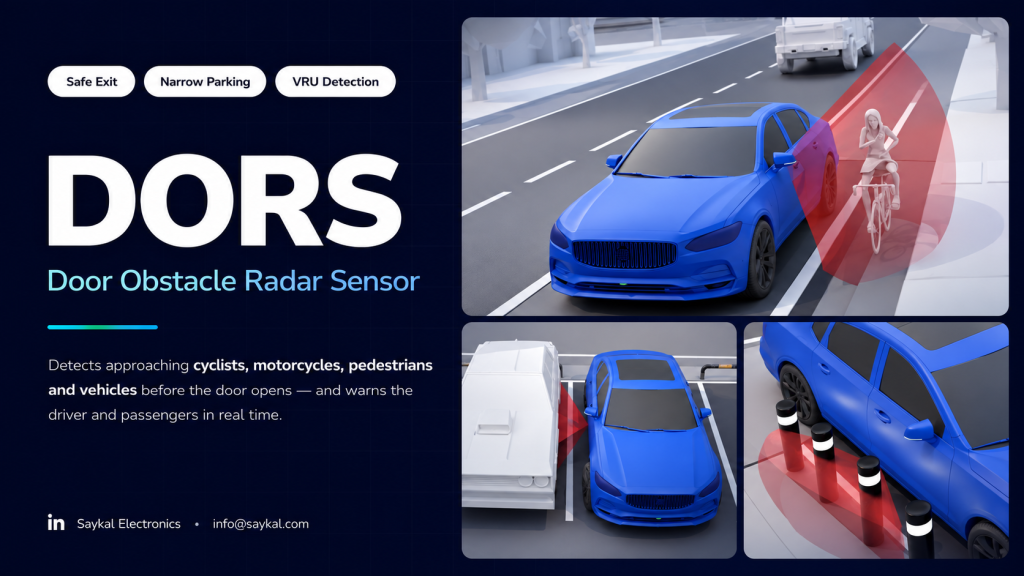
Door Obstacle Radar Sensor is a next-generation automotive radar technology designed to detect obstacles around vehicle doors. It helps prevent door collisions, supports safer door opening in narrow spaces, and enables advanced safety functions such as Safe Exit Assistant. In addition, the sensor can support environmental sensing around the side areas of the vehicle and provide data for Park Assist functions.
Developed by Saykal, the Door Obstacle Radar Sensor (DORS) is designed to detect vehicles, walls, columns, barriers, curbs, and similar obstacles around a parked vehicle before contact occurs. In this way, the radar can work not only as a conventional parking sensor but also as an active sensing system that monitors the movement area of the vehicle door. The system has been developed for both manual and automatic door systems. [1]
Monitoring the Door Movement Area with Radar
Conventional parking sensors mainly focus on the front and rear areas of a vehicle. The Door Obstacle Radar Sensor, however, addresses a different problem: whether the vehicle door can be opened safely after the vehicle is parked.
Especially in narrow parking areas, the vehicle may fit into the parking space while there may still not be enough room to open the door safely. A nearby vehicle, wall, column, or high curb may enter the door movement area. DORS monitors this area with radar and helps detect obstacles before the door makes contact with them.
From Obstacle Detection to Safe Exit Assistant
The application areas of the Door Obstacle Radar Sensor are not limited to preventing the door from hitting stationary objects.
By monitoring the road-side environment, the radar can also support Safe Exit Assistant functions. When the vehicle is parked, the system can detect a potential risk such as an approaching vehicle or cyclist and transmit this information to the vehicle electronics.
In this way, the passenger can be warned before opening the door, or different safety functions can be applied together with the door system depending on the vehicle architecture.
This structure allows different functions such as Obstacle Detection, Narrow Parking Assistance, Safe Exit Assistant, and Smart Access to be considered within the same door electronics architecture. Narrow Parking Assistance can support parking maneuvers in narrow spaces by providing information about obstacles and available space around the side of the vehicle. When used together with other radar sensors on the vehicle, it can also help improve 360° environmental sensing coverage.
Why Radar Technology?
Radar technology is suitable for this application because it enables compact antenna structures in limited mounting areas such as vehicle doors, supports accurate detection of nearby objects, and allows wide field-of-view radar solutions to be developed.
Thanks to its high operating frequency, antenna dimensions can be reduced, making it easier to integrate the sensor behind door handles, door trims, or other plastic vehicle components. This makes it possible to create an invisible sensing layer without affecting the exterior design of the vehicle.
In addition, mmWave radar technology enables the detection of distance and angle information for nearby vehicles, walls, columns, barriers, and similar objects. This supports functions such as Door Obstacle Detection, Narrow Parking Assistance, Park Assist, and Safe Exit Assistant within the same sensor architecture.
Studies on automotive radar technologies also show that radar sensors can be positioned behind plastic and painted body parts. [2]
Why Is the Plastic Part in Front of the Radar Important?
The plastic surface in front of the radar sensor is not completely “invisible” to the radar.
The electromagnetic wave transmitted by the radar antenna may be partially reflected or weakened while passing through different layers such as the sensor cover, air gap, and plastic vehicle surface. Therefore, the material, thickness, and distance between the radar and the plastic part directly affect system performance.
Improper integration may result in effects such as reduced SNR, shorter detection range, narrower field of view, incorrect radar signal propagation toward the target area, and ghost targets.
Academic studies also show that the effects of bumper and radome structures on radar performance should be considered during the design, simulation, and measurement stages. [5], [6]
Why Can a Few Millimeters Affect Radar Performance?
At high frequencies such as 60–64 GHz, the radar wavelength is very short.
According to Saykal’s technical evaluation, the wavelength is very small at high frequencies such as 60–64 GHz. At a center frequency of 62 GHz, the free-space wavelength is approximately 4.84 mm. [7] This is one of the main reasons why even a few millimeters of mechanical change can become important for electromagnetic behavior in radar systems operating in the 60 GHz band.
For this reason, a plastic surface or air gap of only a few millimeters is not a minor mechanical detail from a radar perspective. As the dielectric properties of the material change, the behavior of the electromagnetic wave inside the material also changes.
Therefore, controlled design of the layer thicknesses in front of the radar is important to reduce reflections and transmit the radar signal to the external environment as efficiently as possible. [4]
Can Vehicle Paint Affect Radar Performance?
Yes. The paint and coating system used on the vehicle part in front of the radar can also affect radar signal behavior.
Automotive surfaces usually include several paint layers such as primer, basecoat, and clearcoat. The thickness and electrical properties of these layers can change how the radar wave passes through the plastic surface. [2], [3]
Saykal’s technical study also states that a standard automotive paint system may create an additional layer of approximately 50–100 μm and that metallic or pearlescent pigments should be verified separately in terms of radar performance.
For this reason, radar integration should be validated not only during the design stage but also through measurements performed on the actual production part and the actual paint combination.
From Sensor to System: Radar Integration
A successful automotive radar integration process requires radar hardware, mechanical design, and signal processing studies to be considered together.
In Saykal’s technical approach, the process is handled as a development cycle consisting of the following steps:
material characterization → layer and thickness calculation → 60–64 GHz electromagnetic measurement → characterization of deviations → algorithmic compensation → vehicle-level validation
This approach focuses not only on the performance of the radar sensor under laboratory conditions but also on the overall system performance after integration into the actual vehicle.
Towards Smarter Vehicle Doors
Vehicle doors are becoming systems with more electronic and sensing functions through technologies such as Smart Access, automatic doors, Safe Exit Assistant, and obstacle detection.
Saykal’s Door Obstacle Radar Sensor brings radar technology into the door movement area and provides a new approach for detecting both stationary obstacles around the vehicle and potential risks related to safe exit scenarios.
With its compact radar architecture, wide field of view, and hidden integration capability, DORS is positioned as a radar-based sensing solution for future smart vehicle doors and Vehicle Access systems.
See more. Detect earlier. Open safer.
References
[1] Saykal Electronics, Door Obstacle Radar Sensor Onepager, 2026.
[2] I. Expósito, I. Chin, M. García Sánchez, I. Cuiñas, and J. Verhaevert, “Car Bumper Effects in ADAS Sensors at Automotive Radar Frequencies,” Sensors, vol. 23, no. 19, Art. no. 8113, Sep. 2023, doi: 10.3390/s23198113.
[3] C. Winter, M. Korff, T. Fabbri, S. Holzknecht, I. Weber, and E. M. Biebl, “Permittivity Determination Method for Multilayer Automotive Coatings for Radar Applications at 77 GHz,” IEEE Transactions on Microwave Theory and Techniques, vol. 70, no. 4, pp. 2380–2388, Apr. 2022, doi: 10.1109/TMTT.2022.3147479.
[4] F. Pfeiffer and E. M. Biebl, “Inductive Compensation of High-Permittivity Coatings on Automobile Long-Range Radar Radomes,” IEEE Transactions on Microwave Theory and Techniques, vol. 57, no. 11, pp. 2627–2632, Nov. 2009, doi: 10.1109/TMTT.2009.2031931
[5] E. Jehamy, R. Fiedler, and M. Schick, “Fast Simulation Technique for ACC Radar Integration in Complex Environments at 76–77 GHz,” in 2016 10th European Conference on Antennas and Propagation (EuCAP), Davos, Switzerland, Apr. 2016, pp. 1–5, doi: 10.1109/EuCAP.2016.7481635
[6] N. Modi, M. K. Busineni, and J. Mukherjee, “Design of Wideband and Wide-Angle Matching Bumper to Improve Automotive Radar Performance,” IEEE Sensors Letters, vol. 8, no. 5, pp. 1–4, May 2024, doi: 10.1109/LSENS.2024.3392431
[7] K. Trzebiatowski, M. Rzymowski, L. Kulas, and K. Nyka, “Simple Millimeter Wave Identification System Based on 60 GHz Van Atta Arrays,” Sensors, vol. 22, no. 24, Art. no. 9809, Dec. 2022, doi: 10.3390/s22249809.


